Showing posts with label meeting design. Show all posts

Thursday, June 26, 2008

Concurrent Sessions and Crowdsourcing Process

I've been facilitating sessions that comprise 1/3 of an agenda. So the entire population would be in my session at one point, as well as all of the others, but I only ever see 1/3 of the group at a time. We're working towards the same objective in every session, so inevitably we're identifying opportunities to improve on the sessions as we go, based on observation and specific feedback.

Two things here, really.
  1. Design of meeting format
  2. Adjustment of meeting process

1. Dividing a group into 3 sub groups that interchange is a great idea. This way there's higher participation in each session. There are of course additional space requirements, but it's well worth the investment. Instead of one didactic plenary, you get 3 interactive workshops.

2. I'm a big believer in providing the group with options. Having a plan on how to move forward in a meeting is great, but asking the participants how they think they should move forward given the current progress can sometimes yield superior ideas. Crowdsourcing the very process is a great way to bring mindshare to process, and engage people in considering meeting design as a competency. The process today is being refined through each session as well, so that the final one is a product of meeting design conducted pre-meeting, and real-time adjustments with the benefit of the Wisdom of Crowds.

...

I guess the question is, how can the Wisdom of Crowds be better leveraged in the pre-meeting phase?

Monday, June 9, 2008

Designing and Implementing Multidisciplinary Collaboration

I'm in Boston for the CIMIT hosted Designing and Implementing Multidisciplinary Collaboration meeting. Check out the website here. You'll see links to the agenda and participant bios to get an idea of who is there and what we're doing.

Tonight was the faculty dinner, and one can only hope that the conversation tomorrow is half as interesting. There were a lot of questions about collaboration. What question are we trying to answer tomorrow? A lot of great metaphors emerged in response.

A favourite as depicted by Laura Chasin of the Public Conversations Project was the notion of different people all owning pieces of knowledge that are like one of many pieces of a shattered pane of glass that is a complex problem - whose solution is mandatory to the continued existence of our species. Only when these pieces of glass are brought and fused together through the mechanism of effective collaboration can the greater item/problem be completely addressed.

I will try and do some video postings from the meeting tomorrow. Promises to be exciting. I'm loving Boston. Can't wait to come back when I've got some time on my hands.

Wednesday, June 4, 2008

Place Matters

A recent study out of the University of Leipzig indicates that the chief criteria by which people select friends is geographical proximity. The experiment found a mitful of freshmen being seated in rows at an introduction session. In the study, the most intense relationships among subjects one year after mashing the lot together corresponded most directly with where their random seats were assigned. More than similar interests or values, where people landed dictated who they would befriend.

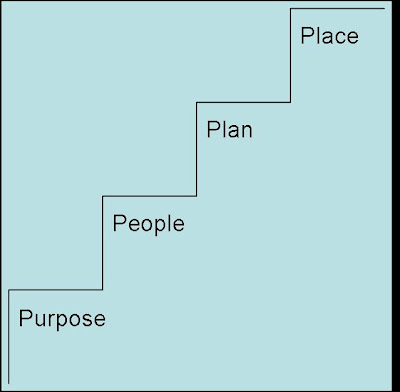
What are the imperatives here for the meeting designer? Rich McLaughlin recently shared with me a basic outline of considerations for designing meetings. You start with establishing the purpose, which will let you know what people need to be invited. Then you build the plan to achieve the purpose, and account for the people. Lastly, you decide on the place. The plan and place are both flexible, and likely change throughout the process. (Pardon me Rich if there are any descrepancies or copyright infringements on the sketch you did for me and my version above!)
How people are acting should influence where a facilitator places them. If people are nodding off, then it's time to consider getting them out of their seats. If they are too chaotic and not paying attention to the purpose, parking them may be the right move. Of course, initial placement of people is always a consideration as well. Usually trusting the group to self organize is the preference. A heavy-handed urge or seating plan is sometimes necessary to get people to surround themselves with those that they might not interact with, though.
The Leipzig study isn't shocking by any stretch, but it's an important reminder of just how critical place and proximity can be in any situation with a social component - which all meetings have. Should a meeting designer be interested in match-making or prescribing relationships/alliances by intentionally seating people near each other?
I think it would be too "command and control" and inappropriate often, but that kind of orchestration might be useful if there was a huge opportunity to catalyze a meaningful synthesis of ideas, organizations, or other, that might not happen without the extra push.

Monday, June 2, 2008

VIVA Las Vegas

It's always interesting to see what is going on out there in cutting edge (read: heavily funded) conferences. Those serving highly specialized healthcare verticals are consistently impressive, if not by format standards than at least by measure of magnitude and frills. Participants are typically proven PhD+'s, and very expert in the field. This means that everyone present has a lot to contribute, and the best meetings give them the opportunity to do just that.

A vascular intervention not-for-profit called VIVA has an annual educational shindig in Vegas that spans disciplines and sounds as well designed as any conference that has playing cards on the splash page... see here.

Just by looking at the website, one can't help but notice a few very compelling meeting components that would figure to improve on the desired outcomes of "fostering collaboration across specialities", and "advancing the field of vascular medicine through multidisciplinary educational efforts". Here are a few:
  1. Laptop Learning - Participants will all have pc's and will be networked together. They will be able to participate in polls, register questions for speakers, provide feedback and follow content through this system. I'm not sure what the platform is, but there are systems such as CoVision that do similar impressive things. Great for interaction and wisdom of the crowds conditions.
  2. Live Cases - As made popular in the '70's by Boston Scientific and others, live demonstration courses enable participants to view a surgical procedure. I'm told that the really powerful courses of this kind also find participants providing real-time feedback, questions, and instructions to the operating physicians. That's a daring and interactive way to draw on the collective intelligence of the audience!
  3. International Faculty - This will help to gather diverse perspectives from very different practices and cultures.

As with many of the most prominent conferences, this one is in Las Vegas. The tagline "what happens in Vegas stays in Vegas" seems like a counter concept to a program where the intent is for people to retain information. I've never been to Vegas for a meeting, but I have to assume they've got the science of meetings down somewhat. I can't help but speculate that the many distractions of sin city have some negative effect on outcomes though. I suppose that this is a necessary trade-off to have a location that can accommodate so many and will actually be a part of the draw.

Sunday, May 4, 2008

Legacy

Before I get too poetic up here on my pedestal; a note in the interests of full disclosure: my inspiration for this posting was none other than the new comic book flick Iron Man. With that out of the way and me totally exposed as the most immature meeting design professional in existence, let's have a look at this looming complexity and how it influences us all, and our meetings.

Me? I want a legacy. I want to live a life of significance and conscience. I want the world to know all about this great life I'm leading, and I want future generations to realize that the world they live in is a better place because of this one great individual. That's an ambitious (you could say over-ambitious, zealous, vain, maybe even delirious) and extreme perspective on the matter. But I don't think I'm the only one.

My interaction with legacy as a meeting designer or facilitator is typically a leader wishing to leave their mark on an organization before retiring. For many, the instinct is to dictate a direction that clearly bears their fingerprint. This is of course at the expense of collaboration, because the urge to have clear ownership is so strong.

I would try to frame a collaborative approach to an individual such as this as a part of the legacy. The true visionary worth remembering has vision enough to see the benefits of inclusiveness and collective intelligence. This is exceedingly difficult if you aren't aware of these motivations in advance of the meeting. Another reason why a thoughtful approach to meeting design that surfaces underlying motivations and interests is so important. Easier said than done though, obviously.

If you're interested: Iron Man did have a legacy with his "Tony Stark" identity. An epiphany of sorts gave him cause to shift what his war mongering legacy would be. The only epiphany I've had is that if I want to make my mark, I'd better get my ass in gear! Decades of waiting for my legacy to form itself hasn't been cutting it. I need a direction though. Maybe I'll start with a suit made of gold-titanium alloy and begin fighting crime. See where that takes me. I have it on good authority that I could pass as Iron Man, and have indeed been called him.

Any reactions to the broad theme of legacy? How does the innate urge that some people have to be remembered play out in your collaborative efforts? Better still, why does the urge exist?

Wednesday, March 19, 2008

Mechanism Design

This year's Nobel Prize went to a few guys that developed the economic theory of mechanism design. The principle deals with the challenge of "asymmetric information", which is what happens when the different parties in a situation have different information and levels of understanding. For instance, if I am selling you diamonds, you would be willing to pay more than the reasonable profit margins I as the dealer am willing to selling them for because you think diamonds are rare. I know they are not. Information asymmetry. Outcome that is not optimal for both parties. The Economist has a good story about the theory here.

I don't want to get into the mathematics, which coincidentally, I don't understand anyway. My interest lies in the translation to the economy that is the meeting room. It is very common that there are experts in a meeting that make for asymmetric information in a meeting. Many people feel that they are therefore entitled to the majority of the speaking time, and the greatest influence over decisions. Mechanism design, with it's intent to create the most effective outcome for all parties, may be a better alternative.

Trying to distribute information as much as possible is one approach to alleviating the asymmetry. Most important in this approach is absolute honesty. If an individual with a monopoly on knowledge in a certain area wishes to lead a meeting in a certain direction, then they may be less inclined to be totally transparent and disseminate all of their knowledge. Escpecially if their unique knowledge is something they are ashamed of.

How might a meeting designer or moderator incentivize people to park their own interests for the benefit of an optimal "mechanism designed" outcome?